Market data
What is signal and what is noise in the raw tape?
research platform
The research layer inside BLKPVNTHR.OS, built as a system in its own right. It exists to try to break ideas, not to flatter them — a candidate has to survive an explicit chain of validation stages before anything downstream will look at it.
Paper-trading research first — live orders are gated.
at a glance
fastapi and uvicorn are
the only runtime dependencies.research_engine, pattern_engine, alpha_discovery,
evidence_fusion, strategy_labthe problem
Most trading research is a backtest and a good feeling. A curve that looks strong in-sample usually does not survive costs, a different period, or a different universe — and nothing in the ordinary workflow forces it to try. The failure is not statistical so much as procedural: there is no gate a bad idea has to get through, and no record of what was already ruled out.
So the design goal was not “find strategies.” It was to make an unproven idea expensive to keep: give every candidate an explicit set of hurdles, make the evidence and its provenance a first-class object, and treat anything that has not cleared the chain as what it is — a hypothesis.
the lifecycle
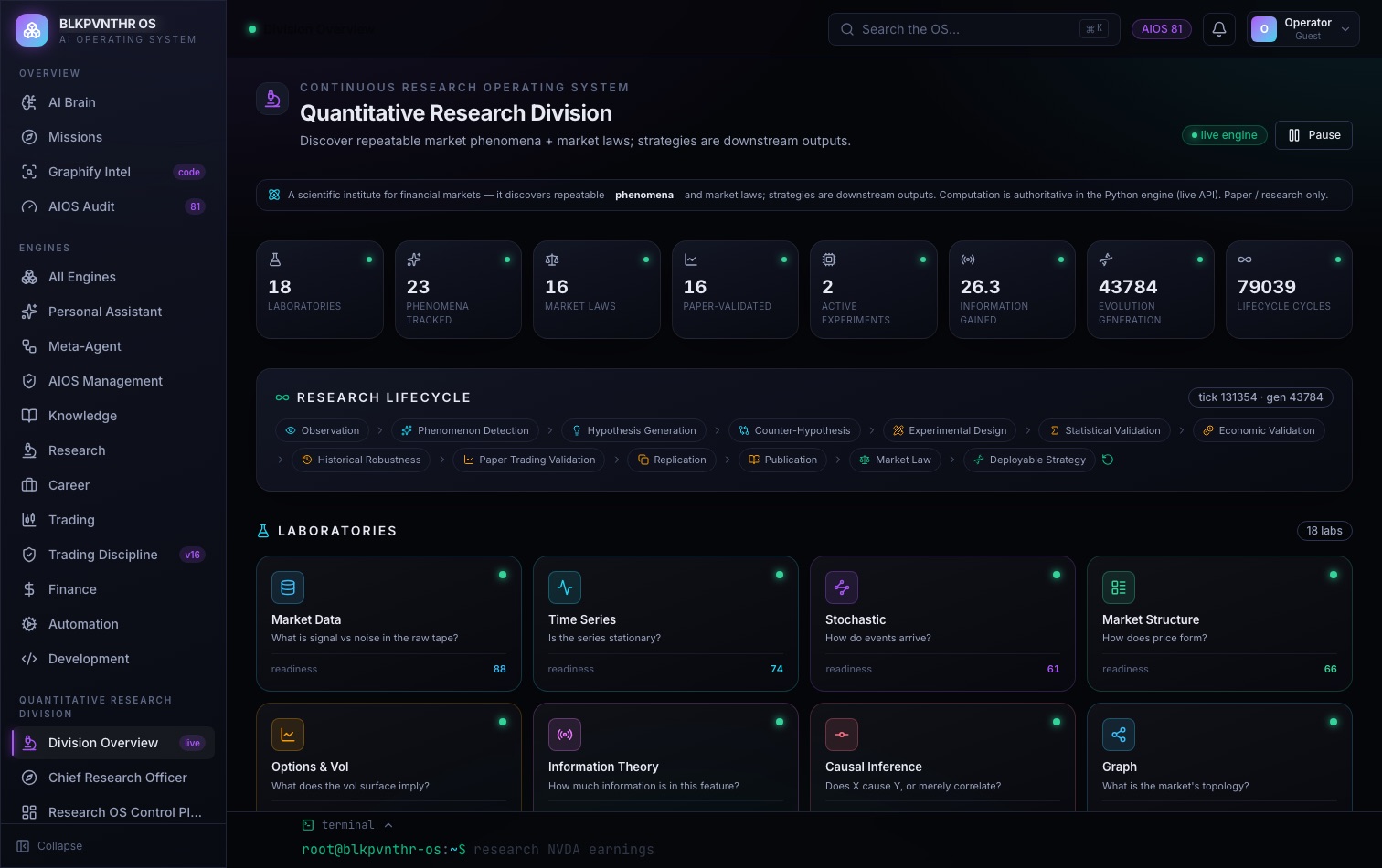
This is the sequence the Research Division actually runs. A candidate enters at the top and is dropped at the first stage it cannot clear.
Each stage depends on the stage above it; a candidate is dropped at the first stage it cannot clear.
Reaching the end of the chain makes a candidate deployable in the paper sense. It does not make it a recommendation, and it is not a signal to act on. See the Financial Disclaimer.
laboratories
Rather than one monolithic model, the division is split into laboratories that each interrogate a single aspect of market structure. Each carries a readiness score, so it is obvious which parts of the system are actually load-bearing and which are still speculative.
What is signal and what is noise in the raw tape?
Is the series stationary?
How do events arrive?
How does price form?
What does the volatility surface imply?
How much information is in this feature?
Does X cause Y, or merely correlate?
What is the market’s topology?
Eight of the eighteen. The rest are visible in the live Research Division.
the engine
The research engine’s only runtime dependencies are FastAPI and uvicorn; the core is plain Python. Fewer dependencies means a deterministic result, a fast cold start, and a service that deploys to a plain systemd unit without a container stack behind it.
evidence_fusion exists so a claim can be traced back to the run and the data behind it.
A result that cannot be traced is not a result.
pattern_engine and alpha_discovery propose; strategy_lab and
the validation stages dispose. The half that generates ideas is deliberately not the half that
grades them.
Research proposes; nothing it produces reaches a live venue on its own. The trading surface is paper-first in the deployed product, with a discipline layer applying risk limits before a strategy can progress.
maturity
This is an actively developed research platform, not a finished product. Some laboratories are production-oriented; others are experimental and carry a low readiness score precisely because they have not earned a higher one yet. It runs paper-trading research first before certifying a strategy for live trading. Live orders are disabled until a strategy consistently averages $100/day net.
The platform publishes no track record. Nothing here is investment advice — see the Financial Disclaimer.