The graph as the primary surface
Engines, missions, workflows, integrations, and data sources are nodes. Selecting a node opens the Inspector, which is how you navigate the system rather than a side panel you occasionally consult.
React Flow
“The graph is the application — every node is clickable, opens the Inspector.” That is the product’s own in-app tagline, and it is the literal design of the system.
BLKPVNTHR.OS is decision intelligence infrastructure: it connects fragmented data, evidence, analytical engines, workflows and human review into systems designed to support traceable, data-backed decisions. Applications, workflows, integrations, experiments, data sources, and system capabilities are modeled as connected resources on an interactive knowledge graph — so a conclusion can be linked back toward the evidence and the steps that produced it.
Live at os.blkpvnthr.com — opens in guest mode, no sign-up.
at a glance
the problem
Data sources, research systems, automation, knowledge, and operational workflows are typically fragmented across disconnected applications. The data lives in one place, the analysis in another, the notes in a third, and the decision nowhere at all.
Each boundary between those applications is a place where context disappears. A hypothesis loses its link to the data that produced it. A metric loses its link to the decision it was meant to inform. A workflow loses its link to the engine it was meant to trigger. The work of holding the whole picture together falls back on the person, every single time.
BLKPVNTHR.OS is a personal answer to that fragmentation, built and operated by one engineer. It is not investment advice, and it is paper-first.
the approach
Rather than another dashboard, BLKPVNTHR.OS models everything it knows about as a resource, and every relationship between those resources as an edge. The graph is not a visualization bolted onto the app. The graph is the app.
Engines, missions, workflows, integrations, and data sources are nodes. Selecting a node opens the Inspector, which is how you navigate the system rather than a side panel you occasionally consult.
React Flow
Domain-specific engines connect specialized data, models, tools, and workflows to the shared decision infrastructure. New systems can be introduced with their own routes and operational boundaries without rebuilding the platform around each use case.
/engines/*
The landing surface is a terminal at root@blkpvnthr-os:~$. Typing start
opens the AI Brain. Commands are a first-class way into the system, not a hidden power-user mode.
Command interface
Evidence and provenance are modelled explicitly. The architecture is designed so conclusions can be linked to their supporting data, experiments, assumptions, and processing steps, and so outputs distinguish sourced values, calculations, assumptions, and generated interpretation.
evidence_fusion
Workflows, missions, and an event bus compose engines into repeatable operations, so automation is assembled from parts that already exist rather than written from scratch each time.
/workflows
The same operating model is designed to serve an individual tracking a single domain, and can extend to an organization running many — laboratories, schedules, and pipelines — on one connected graph.
Guest mode available
capabilities
BLKPVNTHR.OS gives a decision system the parts it needs: connecting fragmented data and context, evaluating evidence and assumptions, running analytical and scenario-based workflows, preserving provenance and decision history, comparing possible actions, and producing reviewable outputs for the people who make the call. Each domain can define its own data sources, analytical engines, evidence requirements, workflows, and review boundaries on the shared graph-based architecture.
current implementation
The current live deployment uses financial analysis, quantitative research, and paper-trading workflows as a working implementation of the broader decision-intelligence architecture. These modules demonstrate how the platform connects source data, analytical processes, evidence, review boundaries, and recorded actions within one navigable system.
Connected account data supports reporting, goal tracking, and reviewable financial insights through read-only workflows.
/engines/finance
Hypotheses, experiments, evidence, and validation stages are modeled as connected resources so findings remain tied to the work that produced them.
/research-division
Research, risk review, and execution remain separated, demonstrating how the architecture can place explicit controls between analysis and consequential action.
/engines/trading
The same architecture can support additional decision systems in areas such as operations, workforce planning, technical research, program management, risk analysis, and other data-intensive environments. Each implementation can define its own data sources, analytical engines, evidence standards, workflows, permissions, and human-review requirements without rebuilding the underlying platform.
platform capabilities
The AI Brain at /os. Every node is clickable and opens the Inspector.
A memory module and a knowledge base hold context across sessions and across engines.
Workflows, missions, an event bus, a Meta-Agent, and a research scheduler coordinate the engines.
Terminal, Graphify, Vault, Email, Career, and Automation are all reachable as part of one system.
/graphify · /vault · /memory
architecture
The interface talks to orchestration, and orchestration composes the engines. Credentials stay server-side — nothing in the browser holds a provider secret.
The following diagram describes three layers. Each layer is built on the layer below it: the interface layer is built on the orchestration layer, and the orchestration layer is built on the engines layer.
stack
boundaries
You sign in with your bank inside Plaid’s secure widget. The app never sees your bank credentials, and the Plaid secret stays server-side. Balances only: no transfers.
Trading is paper-first. Live orders stay disabled until a strategy clears the paper-trading threshold, and the Alpaca proxy targets the paper API.
Analysis and execution permissions are kept separate, so a research module cannot reach the execution path on its own.
The system is designed not to fabricate financial values, and to trace figures back to the account data or the research run they came from.
Anything with a real consequence is surfaced for review rather than acted on silently.
Connections are established, inspected, and removed by the user. Nothing is linked in guest mode.
These are product design boundaries, not a formal compliance certification. Nothing in BLKPVNTHR.OS is investment advice.
the system
The current live implementation includes finance-oriented engines and workflows. These screens demonstrate how domain-specific data, analytical tools, evidence, and actions can be organized through the shared decision-intelligence architecture.
Six screens from the current live implementation. Scroll, swipe, or use the arrows.
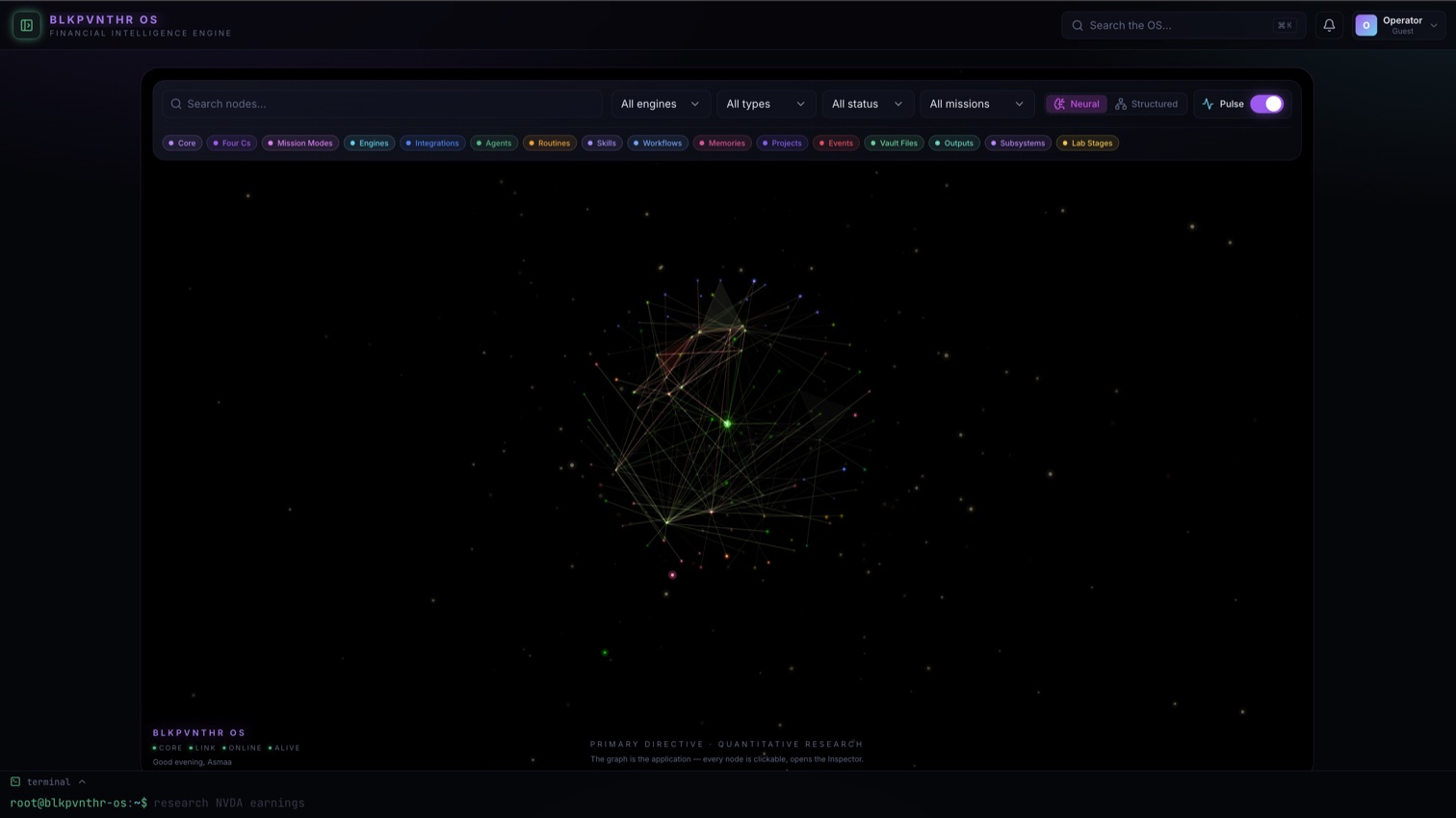
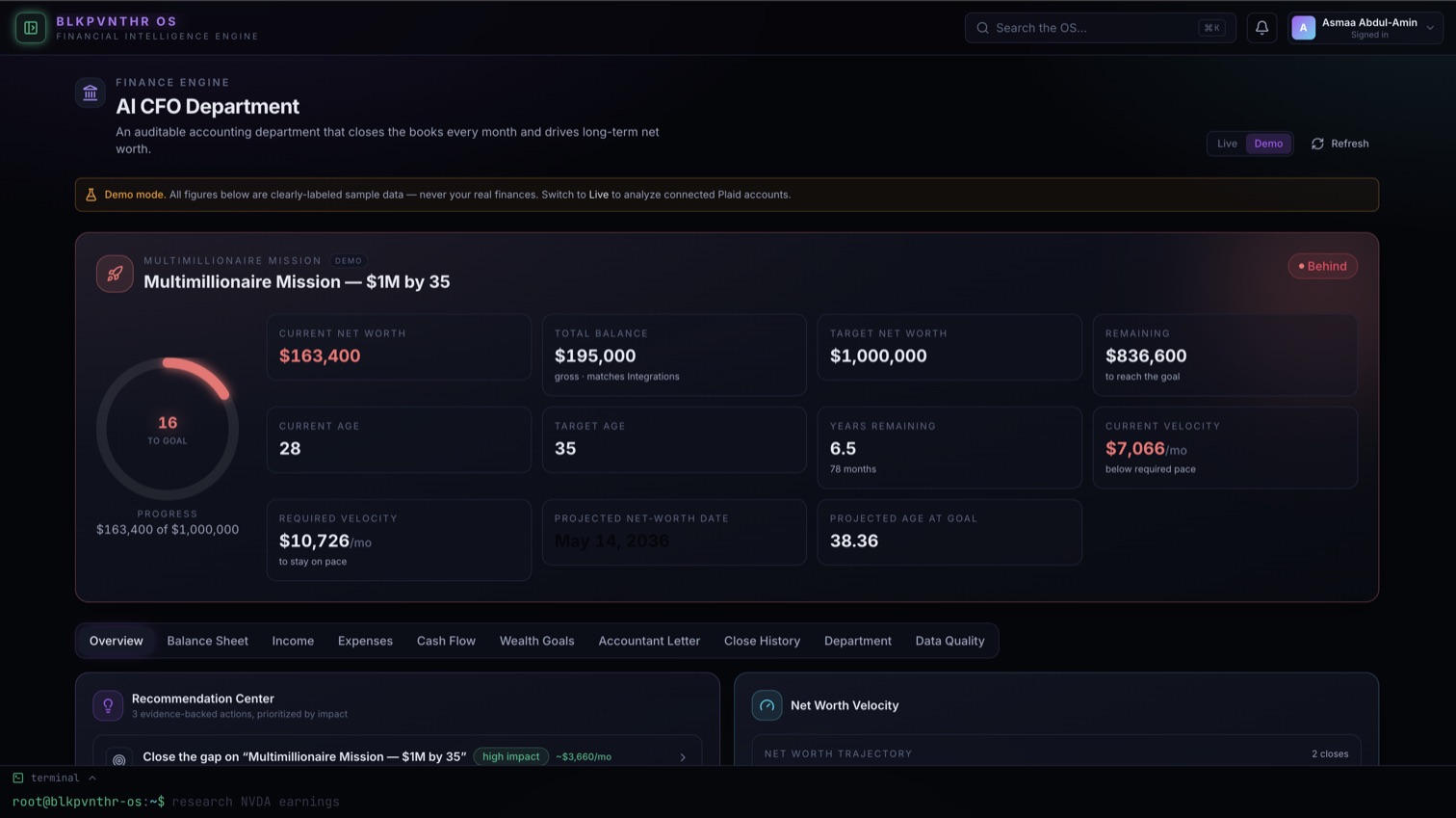
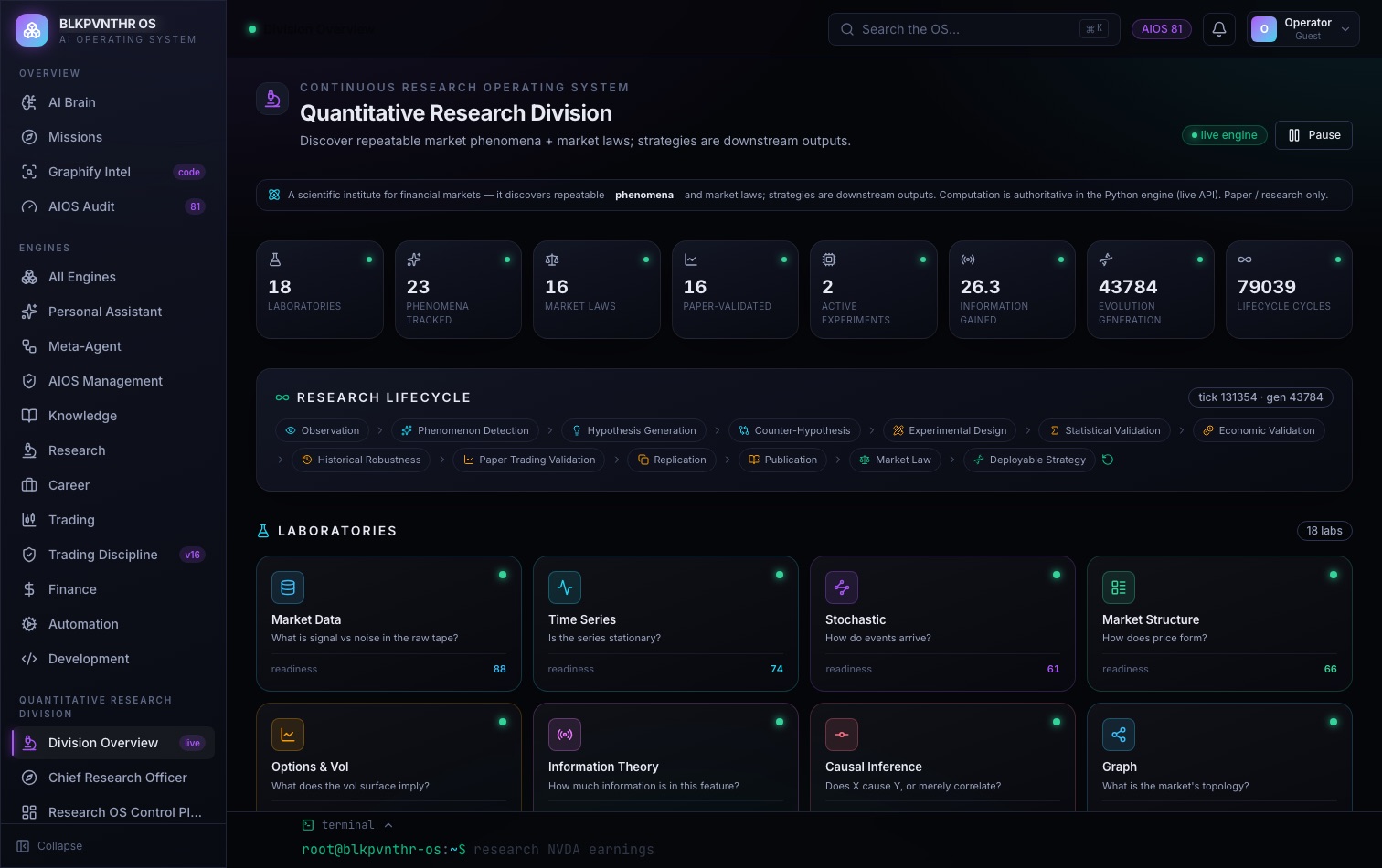
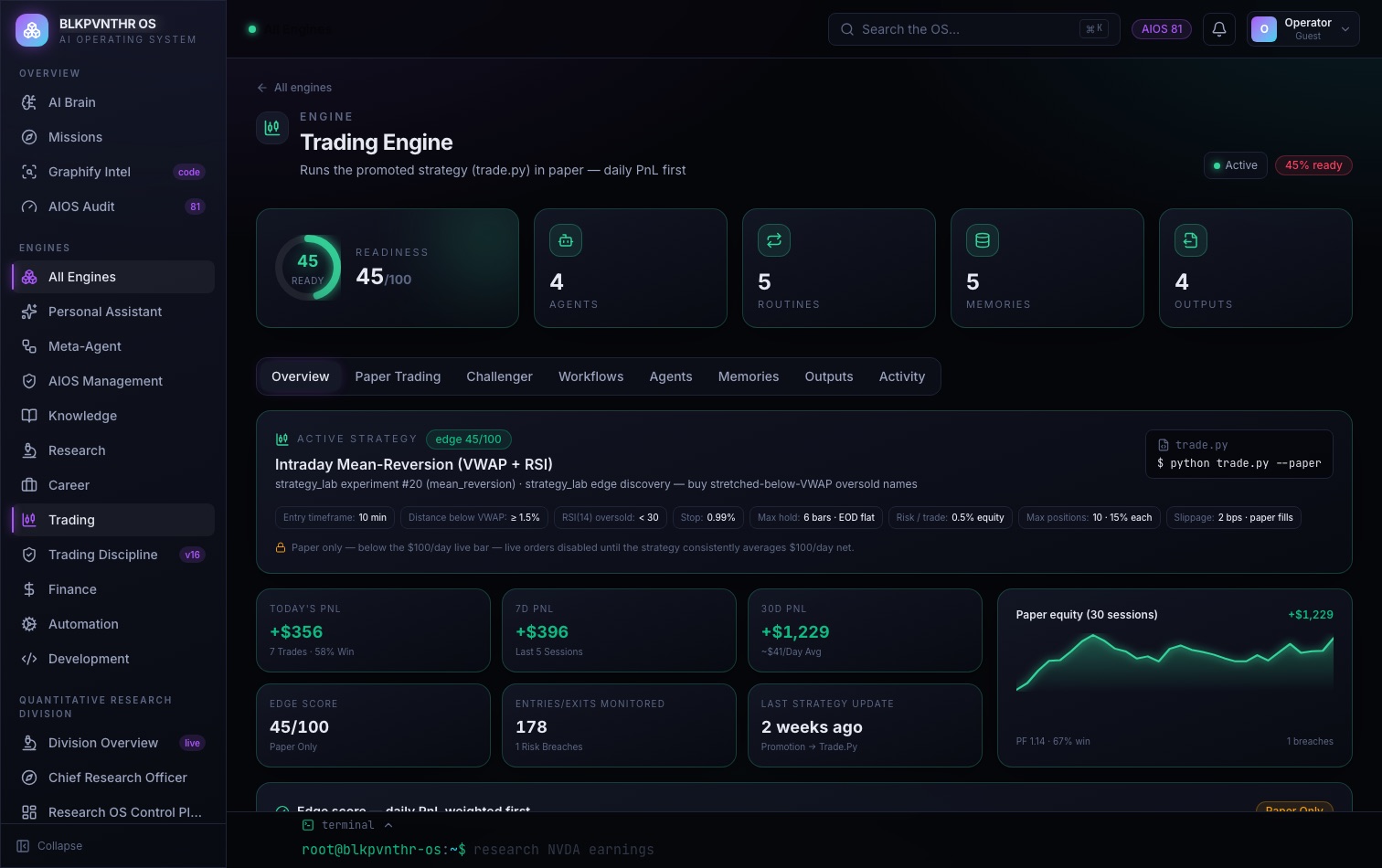
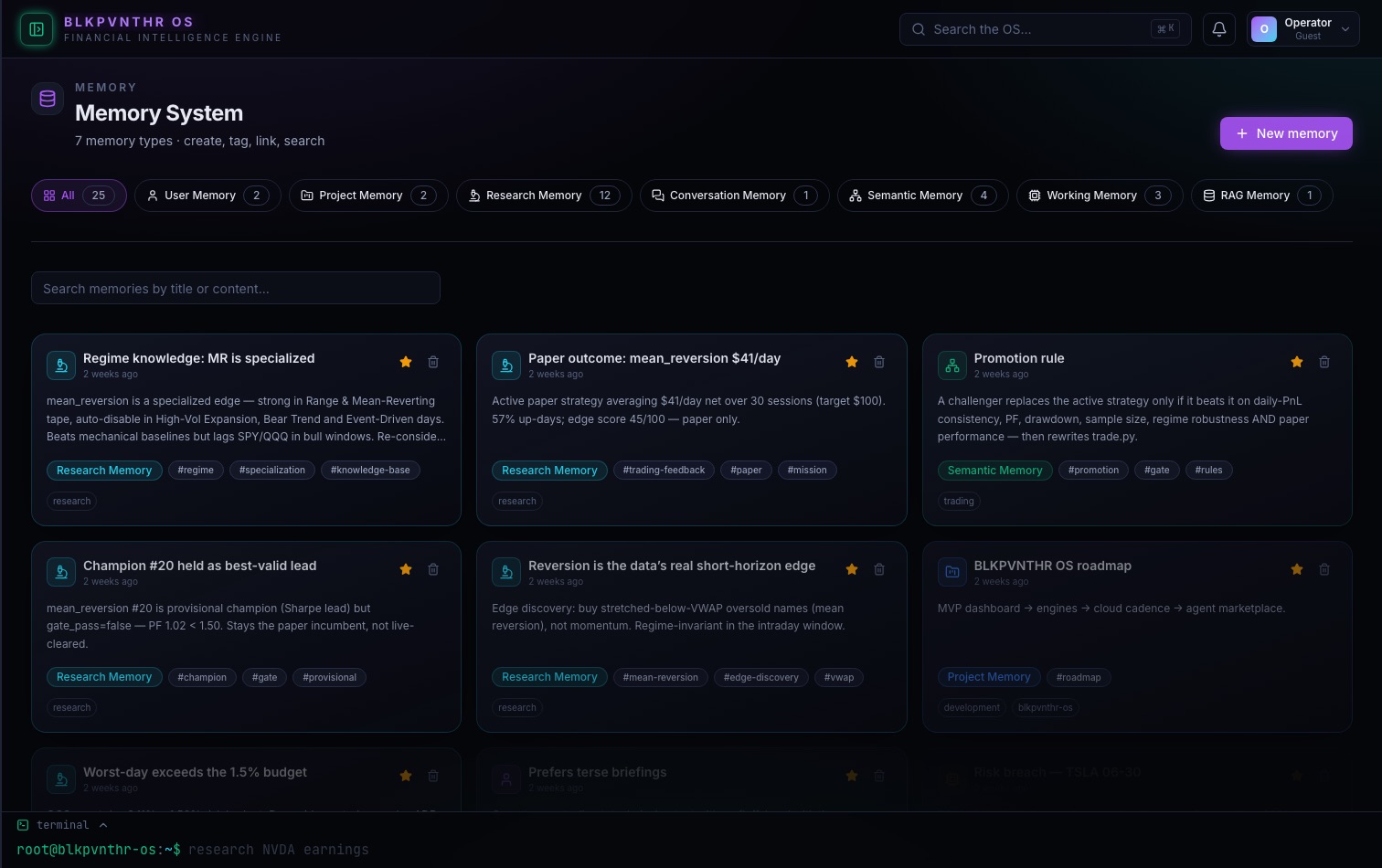
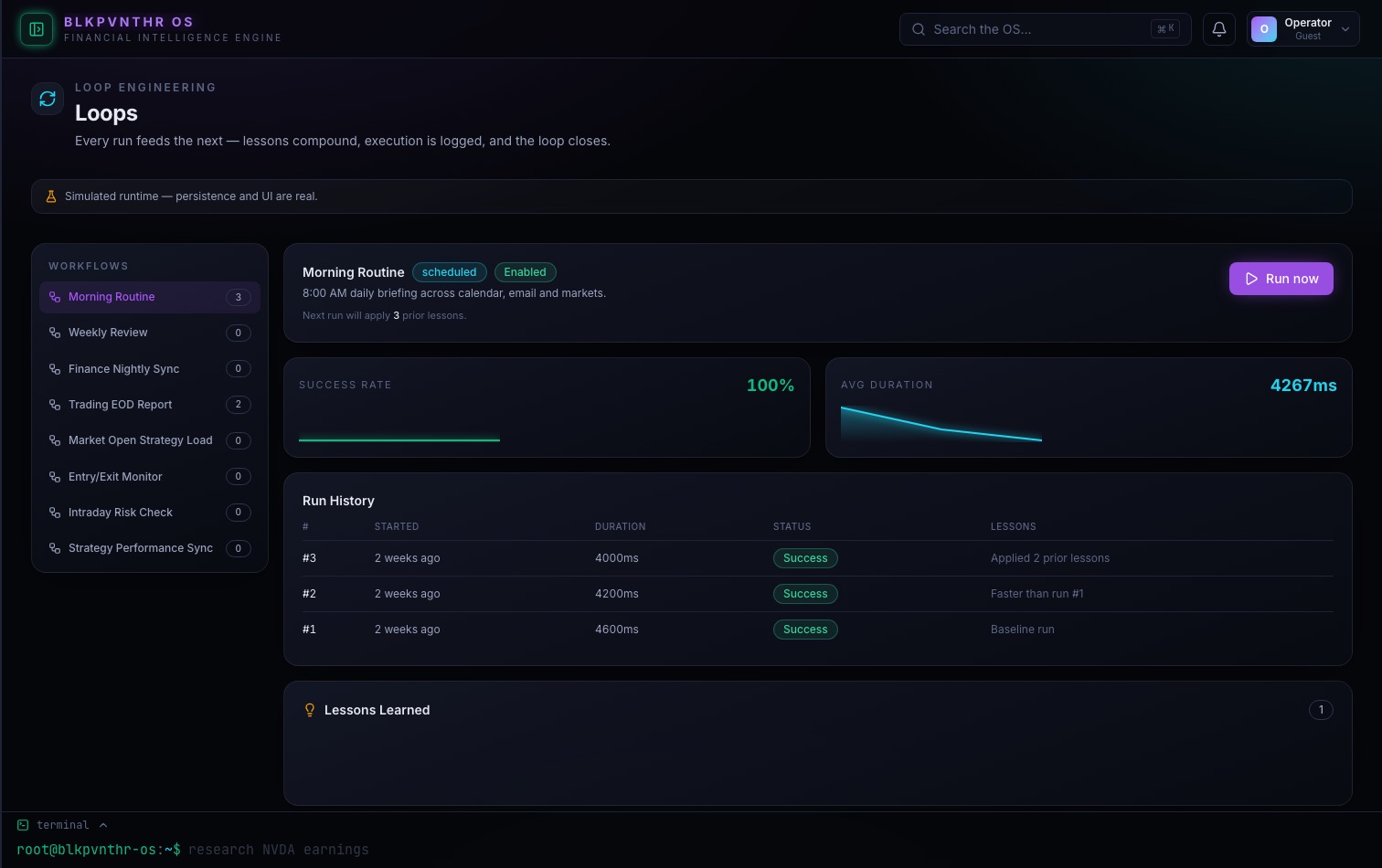

start assembles the AI Brain.
Any values visible are the product’s own demo state, not real finances.
maturity
BLKPVNTHR.OS is an actively developed software platform and working product environment. Some capabilities are production-oriented, while others remain experimental research modules.
The fastest way to judge it is to open it. It runs in guest mode with no sign-up.
disclosure
BLKPVNTHR.OS is a separate software service operated as a distinct product. It may be governed by its own product-specific terms and privacy disclosures, which are separate from the Terms of Use and Privacy Policy that apply to asmaa.dev. Review those before using it.
Nothing in the product is investment advice. Trading is paper-first and live orders are disabled. Bank connections are read-only through Plaid — balances only, no transfers. See the full Financial Disclaimer for details.
Launch BLKPVNTHR.OS to explore the interface, architecture, and connected operating model.